It has been awhile since I have posted anything here. Now, I do all of my posts on my ikebana Facebook page. Please like the Facebook page below and follow along there.
Thanks!

5/22/15

10/15/14
Zoukei Ikebana with Dirt and Glue

Zoukei Exhibit
Judges Prize
Dirt and glue on Styrofoam base
On September 12-13, 2014, I took part in the 23rd
Annual Aomori Zoukei Exhibition. Zoukei ikebana is a totally free form of
ikebana where anything can be used to make a sculptural arrangement. This was
my forth time to participate in the exhibition.
Professor Yokohigashi was the judge, along with Rijicho, the
current headmaster’s mother. The Professor and Rijicho both congratulated me on my
work and said it was very powerful and had a strong impact. They especially liked
the natural cracking of the dirt as it dried. I thought the cracking was a nice
contrast with the curved shape of the piece.
I was so excited and honored to receive the prize! I’m
already looking forward to next year’s exhibition.

A different angle of the work.

Here you can see how large it is.

Judges Prize

My certificate and prize!
10/4/14
Autumn Rimpa Ikebana
This week for my lesson, I did a Rimpa arrangement, which is unique to the Ohara School of Ikebana.
The Rimpa arrangement is a type of ikebana that is based on he highly decorative works of the Rimpa School, which flourished during the Edo Period. Representative artists include Ogata Korin and Tawaraya Sotatsu. The goal is to capture in ikebana the decorative qualities of materials and the overall design effects typical of Rimpa works of art. To this end, the unique characteristics of plants are exaggerated or refined. For the most part, materials used are those found in Rimpa paintings. Mastery of the Rimpa Arrangement depends upon knowledge and study of the original works of the Rimpa artists.
-- taken from the English textbook from the Ohara School of Ikebana, Ikebana for Everybody
Arrangements are usually done in large, flat containers, especially for arrangements done at an exhibition. But for personal study and practice, the use of two Basic Moribana containers can also be used. All of the materials, except the small chrysanthemum, were from my teacher's yard. I was lucky to find interesting and unusual shapes with the Toad lily, and the the Japanese Pampas Grass (susuki) was a beautiful shade of red.
The arrangement spreads out horizontally, giving full play to the shapes of the Toad lily. The small chrysanthemums give a nice contrast and focal point connecting the two containers by placing a small group of them in each. Last, I added the susuki, which was the most difficult part for me. They spread out throughout all of the groups helping to unify the work as a whole. The susuki leaves also help to connect the groups to each other. Showing the surface of the water is also a point in this arrangement. It helps to give the arrangement a light feeling and helps the viewer to feel the cool fall breeze blowing over the surface of the water.

rimpa from stephencoler.com on Vimeo.
Please feel free to leave any comments below. I love to hear what you have to say.
The Rimpa arrangement is a type of ikebana that is based on he highly decorative works of the Rimpa School, which flourished during the Edo Period. Representative artists include Ogata Korin and Tawaraya Sotatsu. The goal is to capture in ikebana the decorative qualities of materials and the overall design effects typical of Rimpa works of art. To this end, the unique characteristics of plants are exaggerated or refined. For the most part, materials used are those found in Rimpa paintings. Mastery of the Rimpa Arrangement depends upon knowledge and study of the original works of the Rimpa artists.
-- taken from the English textbook from the Ohara School of Ikebana, Ikebana for Everybody
Arrangements are usually done in large, flat containers, especially for arrangements done at an exhibition. But for personal study and practice, the use of two Basic Moribana containers can also be used. All of the materials, except the small chrysanthemum, were from my teacher's yard. I was lucky to find interesting and unusual shapes with the Toad lily, and the the Japanese Pampas Grass (susuki) was a beautiful shade of red.
The arrangement spreads out horizontally, giving full play to the shapes of the Toad lily. The small chrysanthemums give a nice contrast and focal point connecting the two containers by placing a small group of them in each. Last, I added the susuki, which was the most difficult part for me. They spread out throughout all of the groups helping to unify the work as a whole. The susuki leaves also help to connect the groups to each other. Showing the surface of the water is also a point in this arrangement. It helps to give the arrangement a light feeling and helps the viewer to feel the cool fall breeze blowing over the surface of the water.
Rimpa Arrangement
Toad lily, small chrysanthemum, Japanese pampas grass (susuki)
You can see in the above picture how it stretches out horizontally, but there is also a depth to it that doesn't really come forth in the picture. So, I decided to take a video of it to show that off. (If you click on the four arrows that are pointing out in the lower right-hand corner next to the vimeo logo, it should make the screen larger.)
rimpa from stephencoler.com on Vimeo.
Please feel free to leave any comments below. I love to hear what you have to say.
8/6/14
Summer Ikebana In a Vase
Summer is in full swing here in Japan -- it is hot and muggy most of the time, making for long days where you don't want to do anything because of the heat. I like the cold winter months much more than the hot summer months. But, it has not been that bad this year. The hot weather came later than usual, and I am happy for that.
In the summer, it's important to find ways to help keep yourself cool. One of my favorite ways is with a cool feeling ikebana arrangement. Just looking at an arrangement can help to cool you off, and you get to enjoy the beauty of the arrangement, too.
This week, for my weekly lesson, I did an arrangement in a vase. The Japanese witch-hazel has many large leaves on the branches. To achieve a cool feeling, you have to cut off many of the leaves and expose the beautiful gray/brown color of the branches. The leaves are a beautiful dark green and feel fresh and alive. Amongst the branches I inserted a couple of purple Chinese bellflowers. They rise up tall in the arrangement, showing the elegant line of the stem. To me, a purple and green arrangement always feels cool and refreshing.


In the summer, it's important to find ways to help keep yourself cool. One of my favorite ways is with a cool feeling ikebana arrangement. Just looking at an arrangement can help to cool you off, and you get to enjoy the beauty of the arrangement, too.
This week, for my weekly lesson, I did an arrangement in a vase. The Japanese witch-hazel has many large leaves on the branches. To achieve a cool feeling, you have to cut off many of the leaves and expose the beautiful gray/brown color of the branches. The leaves are a beautiful dark green and feel fresh and alive. Amongst the branches I inserted a couple of purple Chinese bellflowers. They rise up tall in the arrangement, showing the elegant line of the stem. To me, a purple and green arrangement always feels cool and refreshing.
Nageire, arrangement in a vase
Japanese witch-hazel, Chinese bellflower
In this arrangement, I have used only 3 branches of the witch-hazel and 2 stems of the bellflower; yet, it feels large and full of life. Paying special attention to the movement of the branches to show off their individual beauty and character is what makes ikebana special and different from Western style floral arrangements. Using fewer branches also helps to make the arrangement feel cool. The large space above the vase created by the curving branch of the witch-hazel stretching up toward the sky makes a beautiful space for the bellflower to be inserted. The tall bellflower in the space also helps to make the arrangement feel cool and refreshing.
I thought it would be interesting to show a view from the side.
Here you can see how far forward it stretches. But, you don't notice it when looking at it from the front -- part of the magic of the Ohara School of Ikebana!
I hope you are staying cool in your part of the world. Maybe this will help to cool you off and make you feel refreshed.
As always, please feel free to leave a comment in the comment section below.
7/1/14
Early Summer Landscape Moribana
This week for my lesson, I did a Landscape Moribana arrangement depicting early summer near the bank of a pond.
In Landscape Moribana, the arranger expresses the natural scenic beauty of the materials being used. Having an understanding of the natural growth characteristics of the plants, the environment, and the seasonal aspects of the materials is important when creating a landscape arrangement. The feelings and the creativity of the arranger are also part of the work.
In the front of the container, Spiraea thunbergii stretches out over the edge of the container creating the ground near the water’s edge. The bulrush rises up tall in the arrangement, leaning slightly forward, helping to bring the viewer into the arrangement. The bulrush is found naturally at the waters edge along the bank, so it is placed behind the Spiraea. In the back of the container, calla lily that has just begun to bloom peeks out from the white speckled leaves of the plant. The leaves of the calla lily stretch out over the surface of the water, helping to create the illusion of the flowers growing up out of a pond.
Within the small confines of the container, three different spaces have been created — the ground, the bank, and the water. The large surface of the water helps to give the arrangement a cool and refreshing feeling, perfect for the hot days of summer.

Spiraea thunbergii, bulrush, calla lily
I'll leave you with a haiku by the famous poet, Matsuo Basho, which I think is perfect for this arrangement.
古池や
蛙飛び込む
水の音
furu ike ya
kawazu tobikomu
mizu no oto
an old pond
a frog leaps
the sound of the water
furu ike ya
kawazu tobikomu
mizu no oto
an old pond
a frog leaps
the sound of the water
6/14/14
Father's Day Ikebana, 2014
I wanted to make an arrangement for my dad for Father's Day again this year. He liked the arrangement last year, so I hope that he likes the arrangement this year, too.
I thought about what I could do, something in a container or something in a vase. Last year I did something in a container, but I did a very simple arrangement for him. I wanted to do something that felt a little more natural than last year, so I decided to do a landscape arrangement. He loves the outdoors. When I was little he took me fishing, hunting, and camping. So, I thought a landscape arrangement would be perfect.
I would love to have created a landscape of Arkansas, but I can't get any materials like that here. So, I created a Japanese landscape, but I think it could translate to America, too.
I used Dodan-tsutsuji, a shrub native to Japan, some green Solomon's Seal, and the purple flower is Campanula. The branch that stretches out in the back is reflected on the surface of the water in the suiban and helps to create a cool feeling. The green and purple color combination also help to make it feel as if a cool breeze is blowing. I thought this might be something you would see on the bank of a lake or river. Maybe if you cast a line out, you just might catch a fish!
I hope my dad has a wonderful Father's Day and gets to do something fun and eat something good!
Happy Father's Day, dad.
I love you!
I thought about what I could do, something in a container or something in a vase. Last year I did something in a container, but I did a very simple arrangement for him. I wanted to do something that felt a little more natural than last year, so I decided to do a landscape arrangement. He loves the outdoors. When I was little he took me fishing, hunting, and camping. So, I thought a landscape arrangement would be perfect.
I would love to have created a landscape of Arkansas, but I can't get any materials like that here. So, I created a Japanese landscape, but I think it could translate to America, too.
 |
| Realistic Landscape Moribana Dodan-tsutsuji, Solomon's Seal, Campanula |
I used Dodan-tsutsuji, a shrub native to Japan, some green Solomon's Seal, and the purple flower is Campanula. The branch that stretches out in the back is reflected on the surface of the water in the suiban and helps to create a cool feeling. The green and purple color combination also help to make it feel as if a cool breeze is blowing. I thought this might be something you would see on the bank of a lake or river. Maybe if you cast a line out, you just might catch a fish!
I hope my dad has a wonderful Father's Day and gets to do something fun and eat something good!
Happy Father's Day, dad.
I love you!
5/10/14
Mother's Day Ikebana, 2014
Last year, my mom loved the arrangement I did for her; so, I thought I would make her another one this year.
Her favorite color is yellow, so I chose some beautiful Oncidium. The small orchids are very delicate and bright looking. I thought something purple would look good with that, so I found some purple Alstroemeria. I wanted to do a Radial Form arrangement, so I needed some type of green to bring the arrangement together. I saw some Dracaena "Song of India." The bright green colors would look nice with the yellow and purple. There was also some Asparagus near the Dracaena that would add a nice contrast to the arrangement, so I picked out a few stems of that, too. The white container is an Ohara School of Ikebana vase called, Asuka. I love the big "belly" it has and the small feet that lift it up, making it look elegant.

It's a happy looking arrangement that will put a smile on her face (and will probably become the screen saver on her computer!). I love the energy it has, stretching out to both sides, ready to give you a bright, cheery hug -- just like my mom!
Happy Mother's Day to a fantastic woman who always looks on the bright side of things and is there with a helping hand when needed. She has a great smile that is contagious and has never met a stranger. She supports those around her, often sacrificing her needs for others. She has always supported me in whatever I've done and is my biggest cheerleader. She is my mom, and I am proud to have her in my life.
Love you, mom!
Happy Mother's Day!
Her favorite color is yellow, so I chose some beautiful Oncidium. The small orchids are very delicate and bright looking. I thought something purple would look good with that, so I found some purple Alstroemeria. I wanted to do a Radial Form arrangement, so I needed some type of green to bring the arrangement together. I saw some Dracaena "Song of India." The bright green colors would look nice with the yellow and purple. There was also some Asparagus near the Dracaena that would add a nice contrast to the arrangement, so I picked out a few stems of that, too. The white container is an Ohara School of Ikebana vase called, Asuka. I love the big "belly" it has and the small feet that lift it up, making it look elegant.
Radial Form (front view only)
Oncidium, Alstromeria, Dracaena "Song of India", Asparagus
It's a happy looking arrangement that will put a smile on her face (and will probably become the screen saver on her computer!). I love the energy it has, stretching out to both sides, ready to give you a bright, cheery hug -- just like my mom!
Happy Mother's Day to a fantastic woman who always looks on the bright side of things and is there with a helping hand when needed. She has a great smile that is contagious and has never met a stranger. She supports those around her, often sacrificing her needs for others. She has always supported me in whatever I've done and is my biggest cheerleader. She is my mom, and I am proud to have her in my life.
Love you, mom!
Happy Mother's Day!
4/6/14
Ikebana Arrangements by My Students
I thought I would share some pictures of some of the ikebana arrangements that my students do during their lessons. I have a couple of intermediate students and many beginning students. I try to teach them according to their ability, yet give them a challenge each week during their lesson.
There is a mix of the seasons along with a mix of forms and styles.
I hope you enjoy the pictures as much as I enjoy teaching!
There is a mix of the seasons along with a mix of forms and styles.
I hope you enjoy the pictures as much as I enjoy teaching!
 |
| Inclining Form |
 |
| Inclining Form |
 |
| Rising Form |
 |
| One-Row Form |
 |
| One-Row Form |
 |
| Radial Form |
 |
| Circular Form |
 |
| Circular Form (from above) |
 |
| One-Row Form |
 |
| One-Row Form |
 |
| Circular Form |
 |
| Heika, Upright Style |
 |
| Upright Style |
 |
| Rising Form |
 |
| Rising Form |
 |
| Rising Form |
 |
| Inclining Form |
 |
| Inclining Form |
 |
| Rising Form |
 |
| Rising Form |
 |
| Radial Form |
 |
| Inclining Form |
 |
| Inclining Form |
 |
| Radial Form |
As always, please feel free to leave a comment below!
2/23/14
Rhodea Japonica, an Ancient Ikebana Material
Since ancient times, rhodea has been used extensively in artificial leaf groupings of the greatest ingenuity in rikka and other floral styles. In the ikebana of the Ohara School, one-clump arrangements of rhodea in fixed leaf groupings appear in the Traditional Method in both the Landscape Arrangement and in the Color Scheme Arrangement, and both leaf groupings are governed by strict rules.
Rhodea is always composed in a single group of eight leaves -- en even number. This method makes the most of the plant's natural growth pattern and is the major feature that distinguishes rhodea from most other materials.
If one observes rhodea growing in pots and elsewhere, the leaves will be seen to grow symmetrically from the center of the clump, with opposing leaves emerging at about the same time. This growth pattern is represented by the application of the techniques of the one-clump method to create the best, most unified form with a fixed number of eight leaves.
It should be noted that in its natural state, rhodea produces leaves that emerge sideways to the right and left, and the plant's appearance as a whole lacks forward and backward depth. In a work of ikebana, this would not produce a very beautiful effect, nor would it allow for the addition of other materials. Thus, when rhodea is arranged, the leaves are grouped not according to their natural appearance, but lengthwise as if viewed in depth from front to rear. Consequently, in what is regarded as the parent grouping, the same number of leaves -- three in the rear and three in the front -- are positioned with their upper surfaces facing the center of the clump. At the side of this six-leaf grouping, two leaves represent the so called child grouping. Long, large leaves are used in the parent grouping, and small, short ones in the child grouping. The red berries of rhodea are positioned near the central area of the clump.
In the Traditional Method in the Landscape Arrangement, rhodea is always composed in the Upright Style in the Near-View Depiction. Therefore, the groupings are created with leaves in their natural lengths regardless of the size of the suiban.
--The Traditional Ikebana of the Ohara School,
The Traditional Method in the Landscape and Color Scheme Arrangements
by Houn Ohara, Third Headmaster of the Ohara School
As you can tell from the quote above from the book by Houn Ohara, rhodea has a long history in ikebana and is very specific in the way in which it is arranged. It is a winter material and can be used not only in the Traditional Method, but can also be used in a rimpa arrangement and also in a nageire arrangement. It is a refined material and looks gorgeous in it's arranged state.
I was lucky enough to be able to do an arrangement this winter using the material. It is expensive (about $20 for 10 leaves and one clump of berries), and is getting harder to find here in Japan. Usually, it is used during the new year, but can also be used throughout the winter. A couple of weeks ago (yes, this post is a little late in getting up), there was one set of leaves and a clump of berries left over from the new year at the flower shop, and they were kind enough to give me a discount on them (about $10)! I was excited to try my hand at this very technical yet beautiful arrangement.
As mentioned above, there are set rules for the placement, length, and angle of the leaves. The position of the berries is also set. Following the rules produces a beautiful one-clump depiction of the material that gives a sense of movement within the container. The diagram below, also taken from the above mentioned book, shows the arranging method for rhodea and where to place each leaf within the shippo.

Using this as a guide, along with advice from my teacher, I was able to create a beautiful clump, although it took me about an hour to get everything correct! Needless to say, I was very happy when I was finished. After arranging the rhodea, I covered the surface of the suiban with club moss. It is important to cover the entire surface of the container with the club moss because it is winter and also because rhodea is in no way associated with being near the water. I was lucky enough to be able to use club moss that my teacher had used for an arrangement she did the week before. If I were to have had to cut and arrange all of the club moss, I would have had to spent another hour on the arrangement, which would have been fine with me; but I'm glad I didn't have to! Last, I used small chrysanthemums to finish the arrangement. A small group positioned at the base of the clump near the berries, and another small group used as the Object and its filler.

Rhodea japonica, small chrysanthemum, club moss
Near View, Upright Style

Here's a view from the side to show how the leaf group tilts forward to bring the viewer into the arrangement.

The Landscape Arrangement form is truly unique to the Ohara School of Ikebana. Respecting the seasonal characteristics and natural growth patterns of plants, an arrangement that expresses the beauty of a natural scene can be captured in the small confines of a container. Being able to do this takes years of practice and lots of skill. I still have a ways to go on my ikebana journey, but I am enjoying the "views" along the way.
I hope each of you are doing well in your part of the world!
Please feel free to leave a comment below. I would love to hear about your ikebana journey.
2/3/14
Amaryllis Ikebana, Remembering My Grandmother
Amaryllis always reminds me of my grandmother.
She had a big picture window in her living room with a big "table" in front of it (which was actually the old console of their TV with a cloth over it). It was filled with different potted plants. But my favorite were the amaryllis. She had all different colors -- red, pink, white, red with white spots, and I can even remember a yellow one. They always bloomed during the winter months, but she was good enough that she could also get them to bloom out of season.
For Christmas one year, she gave all of the grand kids a potted amaryllis bulb that we would have to water and could then watch grow. I loved watching the single stalk rise up out of the bulb and bloom in a colorful display of trumpets all around the top of that lonely, green stalk. I had mine for several years before I finally let it die.
Now every time I see an amaryllis, it makes me think of her. She was a simple country woman who loved to garden and display her flowers on the table during the summer months. And I know she enjoyed the beauty of the amaryllis that she had in the picture window -- she had so many!
This last week, I did an arrangement using amaryllis and it made me think of her.
I think she would like this arrangement very much.

Amaryllis and mustard flower
Upright Style, Traditional Method in the Color Scheme Arrangement
Do you have any special memories of your grandmother? Let me know in the comment section below.
1/28/14
New Year's Ikebana 2014
I have been off the blog world for a while.
I had gone home for my winter break for a month and was busy with things there. I had also left my camera in Japan, so I couldn't really take any pictures while I was home. I know that's not really an excuse, but . . .
Better late than never, here is my New Year's ikebana arrangement.
As in years past, I did an arrangement for my friends hanko shop window. Click here for 2012 and here for the 2011 arrangements. This year, I would be in America during the New Year, so I made an arrangement ahead of time that he could put in the window while I was gone. I left for America on the 22nd of December, later than normal. It would only be a week until it would be time to display the arrangement, so it should be ok. All of the materials I used keep for a long time, and my apartment would be cold while I was out. Everything should be ok, and it was! Yeah!
For the past couple of times, I did heika arrangements, arrangements in a vase. The space for the display is a bit narrow making it difficult to do a large work in the space. This year, I decided that I would do a hana-isho arrangement, one of my favorites (I know I say that about all the forms and styles -- it's just too hard to pick one!), the One-row Form.
He wanted something a little different, so I got five different square containers that are usually used in the New Year osechi box, food served during the New Year's Holidays which symbolize good luck and fortune. They might hold beans, different boiled vegetables, rice, different foods that can last through the holiday season. Of course this time, they didn't hold any food!


I had gone home for my winter break for a month and was busy with things there. I had also left my camera in Japan, so I couldn't really take any pictures while I was home. I know that's not really an excuse, but . . .
Better late than never, here is my New Year's ikebana arrangement.
As in years past, I did an arrangement for my friends hanko shop window. Click here for 2012 and here for the 2011 arrangements. This year, I would be in America during the New Year, so I made an arrangement ahead of time that he could put in the window while I was gone. I left for America on the 22nd of December, later than normal. It would only be a week until it would be time to display the arrangement, so it should be ok. All of the materials I used keep for a long time, and my apartment would be cold while I was out. Everything should be ok, and it was! Yeah!
For the past couple of times, I did heika arrangements, arrangements in a vase. The space for the display is a bit narrow making it difficult to do a large work in the space. This year, I decided that I would do a hana-isho arrangement, one of my favorites (I know I say that about all the forms and styles -- it's just too hard to pick one!), the One-row Form.
He wanted something a little different, so I got five different square containers that are usually used in the New Year osechi box, food served during the New Year's Holidays which symbolize good luck and fortune. They might hold beans, different boiled vegetables, rice, different foods that can last through the holiday season. Of course this time, they didn't hold any food!
Above is a picture of a very gorgeous osechi box. Something like this would be well over $300! And the box itself, depending on what it is made from and how it is decorated, can also be very expensive -- $500 or more.
Some of the food above include the following:
Datemaki -- Sweet egg roll mixed with fish paste, with a texture close to pound cakes. The rolls resemble scrolls which symbolize knowledge and literal talents.
Kamaboko -- White fish cake trimmed with bright pink colors resemble the rising sun. The pink color expresses happiness, and the white color symbolizes sanctity.
Kazunoko -- Salted herring row, at times referred to as "golden diamonds" due to its color.
Kuro-mame -- Sweet black beans, eaten to wish for a healthy year.
Tai -- Red sea bream, associated with the Japanese word "Mede-tai", which refers to happiness and joy.
**the above picture and explanations of the food were taken from the Japan National Tourism Organization homepage**
The above is not your typical box, but I thought it would be fun to show what a lavish one looked like.
The small boxes that I bought are what are placed inside of the larger boxes to separate the food. For all five, I think I paid less than $10. Very cheap for a container if you ask me!
I wanted to use traditional New Year materials, which can be found at any flower shop and even in the grocery stores. The end result, a large arrangement that cold fit into the narrow display space.
 |
| New Year's Arrangement 2014 One-row Form Young pine, painted bamboo, ping-pong chrysanthemum, colwort (ornamental kale), Sarcandra glabra, New Year decoration |
And here it is in the shop window.
A modern take on a traditional New Year arrangement.
I hope that each of you who reads the blog had a wonderful and relaxing New Year.
I wish each of you good health and prosperity in 2014!
Here's to a year filled with beautiful and inspiring flowers.
11/15/13
Fall Ikebana Exhibition 2013, Part 2
On Sunday, November 10, and Monday, November 11, I took part in the annual prefectural fall ikebana exhibition. The weekend before, I and two of my students took part in the city-wide exhibition (click here to see that post), so I have had a busy couple of weeks. But they have been great busy!
About a month ago while at the flower shop getting flowers for one of my lessons, I noticed some very nice, large dried leaves. I asked if they were special order for someone, but the staff said that they were actually left over from an exhibition held in October. That meant I could use them if I wanted to, but I had to think about it. Because they were so big, I would need a large container, and I didn't have any. So, my search for a container began.
I looked around at different second hand shops and even an antique type store, but I couldn't find anything. I asked my teacher if she had any large vases, and just my luck, she did! With that vase, I could use the leaves. Yeah! The next time I was at the shop, I saw that the leaves were still there and immediately bought them. Now, I just had to figure out what to put with them.
I thought I would like to another Bunjin styled arrangement, but it would be difficult to find materials to go with the leaves. One day at my lesson, I noticed that my teacher had a beautiful, old piece of lichen covered persimmon laying out in the corner of her yard. She had been through her garden cleaning things up, getting ready for the winter season, and she had put the old branch (one she had used about 10 years ago) in the pile to be thrown away. I asked if I could use it, and she said yes. I had another material for my arrangement. (When searching for materials, I look everywhere to try and find the perfect materials to use -- while driving, while walking, in the school yard, around the school, around my neighborhood, everywhere!)
I thought that some pine would also go nice with the arrangement, so a friend and I went for a little drive up in the mountains to search for some pine. We finally managed to find some, and after climbing up the tree to get to it to cut it off, I had some pine. Now I needed something to go in the front of the arrangement to give it a focal point.
I went to several different flower shops in several different cities looking for some unusual flowers, but I had no luck. I thought I could also use a potted plant, so I went to several different garden centers and found some huge ornamental cabbage plants that would be perfect. Everything was coming together.
Last, I thought it would be nice to give it a little color, so I decided to add some green chrysanthemums to the arrangement. They would give the arrangement a nice pop of color and help to fill out the space of the work. They would also help to give the arrangement a bit of a fall feel to it.
After a couple of weeks of planning, I finally had my arrangement completed.

It may be hard to tell from the picture just how large this arrangement is, but the ornamental cabbage in the front is about a foot wide! The large leaf probably stood up about three and a half feet out of the container. This is the largest ikebana arrangement I have created, and I think it turned out very well (if I do say so myself!).

It was a dynamic arrangement, and I think I captured the feeling of fall and the coming of the cold winter ahead. This was something that I don't normally do, and people noticed that. I saw these leaves and knew that I had to use them somehow. Since they are dried, I can use them again. Yeah! I thought they would look nice if they were gold-leafed. I could use them in a Christmas or New Year's arrangement, but that won't be this year.
Click here to see the arrangement I did for the spring exhibition.
As always, please feel free to leave a comment below or share the post. Also feel free to +1 the post.

Happy Fall!
About a month ago while at the flower shop getting flowers for one of my lessons, I noticed some very nice, large dried leaves. I asked if they were special order for someone, but the staff said that they were actually left over from an exhibition held in October. That meant I could use them if I wanted to, but I had to think about it. Because they were so big, I would need a large container, and I didn't have any. So, my search for a container began.
I looked around at different second hand shops and even an antique type store, but I couldn't find anything. I asked my teacher if she had any large vases, and just my luck, she did! With that vase, I could use the leaves. Yeah! The next time I was at the shop, I saw that the leaves were still there and immediately bought them. Now, I just had to figure out what to put with them.
I thought I would like to another Bunjin styled arrangement, but it would be difficult to find materials to go with the leaves. One day at my lesson, I noticed that my teacher had a beautiful, old piece of lichen covered persimmon laying out in the corner of her yard. She had been through her garden cleaning things up, getting ready for the winter season, and she had put the old branch (one she had used about 10 years ago) in the pile to be thrown away. I asked if I could use it, and she said yes. I had another material for my arrangement. (When searching for materials, I look everywhere to try and find the perfect materials to use -- while driving, while walking, in the school yard, around the school, around my neighborhood, everywhere!)
I thought that some pine would also go nice with the arrangement, so a friend and I went for a little drive up in the mountains to search for some pine. We finally managed to find some, and after climbing up the tree to get to it to cut it off, I had some pine. Now I needed something to go in the front of the arrangement to give it a focal point.
I went to several different flower shops in several different cities looking for some unusual flowers, but I had no luck. I thought I could also use a potted plant, so I went to several different garden centers and found some huge ornamental cabbage plants that would be perfect. Everything was coming together.
Last, I thought it would be nice to give it a little color, so I decided to add some green chrysanthemums to the arrangement. They would give the arrangement a nice pop of color and help to fill out the space of the work. They would also help to give the arrangement a bit of a fall feel to it.
After a couple of weeks of planning, I finally had my arrangement completed.

Dried Sterlizia augusta, pine, lichen covered persimmon,
ornamental cabbage, chrysanthemum "Anastasia"
It may be hard to tell from the picture just how large this arrangement is, but the ornamental cabbage in the front is about a foot wide! The large leaf probably stood up about three and a half feet out of the container. This is the largest ikebana arrangement I have created, and I think it turned out very well (if I do say so myself!).
Here's a picture of it from the left side so you can also see how far back it stretches.

It was a dynamic arrangement, and I think I captured the feeling of fall and the coming of the cold winter ahead. This was something that I don't normally do, and people noticed that. I saw these leaves and knew that I had to use them somehow. Since they are dried, I can use them again. Yeah! I thought they would look nice if they were gold-leafed. I could use them in a Christmas or New Year's arrangement, but that won't be this year.
Click here to see the arrangement I did for the spring exhibition.
As always, please feel free to leave a comment below or share the post. Also feel free to +1 the post.

Happy Fall!
11/8/13
Fall Ikebana Exhibition 2013, Part 1
This past weekend, I and two of my students participated in the city-wide culture festival that is held every year. People display not only ikebana but also bonsai, Japanese calligraphy, photos, paintings, art, sculpture, and the list goes on. I think that this was my 11th year to participate in the festival -- wow!
This year, one of my more advanced students participated in the festival. She wanted to do a One-Row arrangement using dark colored calla lilies. I asked the flower shop to try and order some lilies, and they ended up having to get them shipped in from Tokyo! This was her second time to do an arrangement for the culture festival, but it was her first time to do a large arrangement like the one she did. She made a beautiful arrangement and should be very proud of herself!

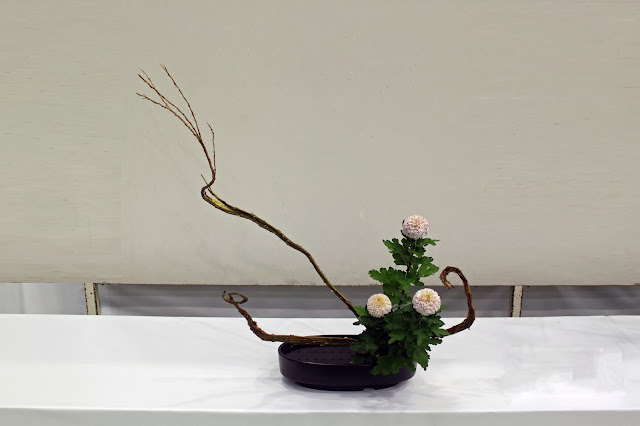

This year, one of my more advanced students participated in the festival. She wanted to do a One-Row arrangement using dark colored calla lilies. I asked the flower shop to try and order some lilies, and they ended up having to get them shipped in from Tokyo! This was her second time to do an arrangement for the culture festival, but it was her first time to do a large arrangement like the one she did. She made a beautiful arrangement and should be very proud of herself!

One-Row Form
Calla lily, carnation, spray carnation, solidago, Homalomena
The other student who participated in the festival for the first time has been doing ikebana for a while, but is still in the beginning stage. She wanted to use some type of branch in the Inclining Form. We went to the flower shop together and found some beautiful "Sekka" willow which would be perfect the type of arrangement she wanted to do. She did a wonderful job and should also be proud of herself!

Inclining Form
Fasciated willow "Sekka", ping-pong chrysanthemum
As for me, I wanted to do something more with a Japanese fell to it, something a little larger in a vase. I wanted to try to do a Bunjin arrangement, a type of ikebana based on a Japanese interpretation of the Chinese bunjin, or literati. Emphasis is placed on the elegance and poetic nature or rare blooms, shrubs, and plants. It is not bound by any specific floral style, and materials may be freely arranged to express the unique beauty of each stem, flower, or leaf.
A friend lent me a beautiful vase that would be perfect for this type of arrangement, so I was ready to go, but I couldn't decide what materials I wanted to use. I thought I would like to use pine and some type of tropical flower along with something bold to place in the front of the arrangement to give it balance. My teacher had a beautiful hydrangea blossom that had partially dried on the bush (it was at least 10 inches across!), and another student had a beautiful branch of aged pine that she let me use. I went to the flower shop and got my tropical materials, and voila! I had my arrangement. All of the materials are arranged as if they are the star of the show, but there is a balance between all of the materials.

Bunjin Arrangement
Dried hydrangea, pine, heliconia
The festival was held for three days and many people came to enjoy all of the different works displayed. I had a great time, and my students did, too! One of them is already looking forward to next year's festival!
This coming weekend, I have another exhibition to prepare for, this one the prefectural fall ikebana exhibit. I have some great materials I found a couple of weeks ago and can't wait to create it and share it with all of you. Look for part 2 soon!
As always, fell free to comment below. Let me know what you think of the arrangements or tell me about your favorite fall flowers. Also feel free to share or +1 it!
10/27/13
Online Ikebana Course Student's Work The Journey Begins
Several students have begun to take the online course that I started with my new website, stephencoler.com. I am so excited for these wonderful students to begin and continue their ikebana journey. I would like to share a couple of pictures with all of you and show you the beautiful art they created.
The first picture is from a student who had studied ikebana in the past, although it had been a while since she had practiced her art. She made a beautiful arrangement with materials that she got from her own garden -- how wonderful is that!

Is that not a beautiful arrangement? I love the pink color of the hydrangeas and the green of the yucca leaves. The open space she created with the low yucca leaf extending out to the right gives the arrangement a sense of movement and elegance. And the container she used for the arrangement also looks very nice. I think she did a wonderful job!
The next picture is from a beginner. She has just started her ikebana journey and is very excited to learn about ikebana. She had to work with her local florist to find the materials, no using materials from her own garden. At least not for now!

This was the first picture that she sent me. For her first time doing an ikebana arrangement, I thought she did an exceptional job! I gave her a little advice about the placement of the roses and the short leaf of New Zealand flax. She revised her arrangement and sent me another picture.

Absolutely beautiful! Her placement of the roses is very elegant, and she has created a nice balance in the arrangement. I hope that she is proud of herself, because I certainly am!
I am so happy for both of these students. They have created a beautiful ikebana arrangement that is sure to bring pleasure to anyone who sees it. It has brought joy to me!
Please feel free to leave comments below.
And if your interested in learning more about ikebana or starting your own journey, please visit my website, stephencoler.com, or click on the link at the top of the page.
The first picture is from a student who had studied ikebana in the past, although it had been a while since she had practiced her art. She made a beautiful arrangement with materials that she got from her own garden -- how wonderful is that!

Yucca and hydrangea, Rising Form
Is that not a beautiful arrangement? I love the pink color of the hydrangeas and the green of the yucca leaves. The open space she created with the low yucca leaf extending out to the right gives the arrangement a sense of movement and elegance. And the container she used for the arrangement also looks very nice. I think she did a wonderful job!
The next picture is from a beginner. She has just started her ikebana journey and is very excited to learn about ikebana. She had to work with her local florist to find the materials, no using materials from her own garden. At least not for now!

Red New Zealand Flax and Rose, Rising Form
This was the first picture that she sent me. For her first time doing an ikebana arrangement, I thought she did an exceptional job! I gave her a little advice about the placement of the roses and the short leaf of New Zealand flax. She revised her arrangement and sent me another picture.

I am so happy for both of these students. They have created a beautiful ikebana arrangement that is sure to bring pleasure to anyone who sees it. It has brought joy to me!
Please feel free to leave comments below.
And if your interested in learning more about ikebana or starting your own journey, please visit my website, stephencoler.com, or click on the link at the top of the page.
Subscribe to:
Posts (Atom)