What do you need to get started doing ikebana?
Here are a few of the basics.
From left to right, are floral wire, bamboo skewers, a sprayer/mister, floral tape, and some scissors.
The floral tape and wire are used sometimes to bind things together or add some extra support to stems. The bamboo skewers are used when doing ikebana in a vase. And the sprayer is used to spray the flowers -- of course, if you had just a regular spray bottle, that would work, too. And lastly, the all-important scissors. Ideally, you would have two pair -- one pair for cutting branches or hard materials, and one pair for cutting flowers. If you use the same pair for everything, the blades will get dull quickly because of cutting through the hard branches. Investing in a good pair of scissors and cleaning them after each use will prolong the life of the scissors.
These are just a few of the containers and vases that I have. I didn't realize I had so many until I got them out to take the picture, and I still had more that wouldn't fit on the desk! I have amassed them over the past 10 years, and most of them are around $20 or less.
Here's a close up of the left side of the desk. The diamond shaped container in the lower left hand corner is the basic container for Ohara-ryu. It is the first container that I bought and still use today. The black vase on the left is the basic vase for Heika, flowers arranged in a vase. The two large round containers are also used often, both for Hana-isho and Moribana. The yellow vase in the foreground was a birthday present from a couple of friends this year. I used it in the previous post to do Hanakanade.
The small, brown vase in the front-middle is one that I made a couple of years ago. The charcoal gray vase behind the one I made is part of a set that I use for Hanamai (my favorite style). It looks a little like the mouth of a dolphin or some sea creature -- I call it my dolphin vase.
The white vase in the back is the basic vase for Hana-isho, and I use it often, too. The long, beige colored container in the foreground is used for One Row Form and for Hanamai. It was also a birthday present from some friends several years ago. And the list goes on and on . . . In Ohara-ryu, anything can be used as a container -- a coffee cup and saucer, a favorite bowl or plate from your kitchen, a wine glass, anything goes. (Try not get distracted by my red couch in the background. But, did you notice the paper cups? I did that as a Zokei work and put lights in it. It's now a light in my living room.)
And last but not least, here we have the kenzan and shippo holders. The kenzan (my grandmother always called them frogs; why, I have no idea), or needle-point holder, are used in the containers. You insert the stems of the materials into the kenzan, which holds the flowers up or out at an angle. As you can see from the picture, there are many different sizes and shapes. Depending on the size of the container and how many materials you use determines which kenzan you should use for your arrangement. The shippo in the upper right hand corner, a traditional metal holder with partitions, is used when doing landscapes or when using large branches.
At the very least, you need some scissors, kenzan, a container, and of course some flowers.
Do you have everything you need to get started?
ikebana and life in japan
a blog about ikebana and life in japan
9/4/11
8/12/11
Hanakanade
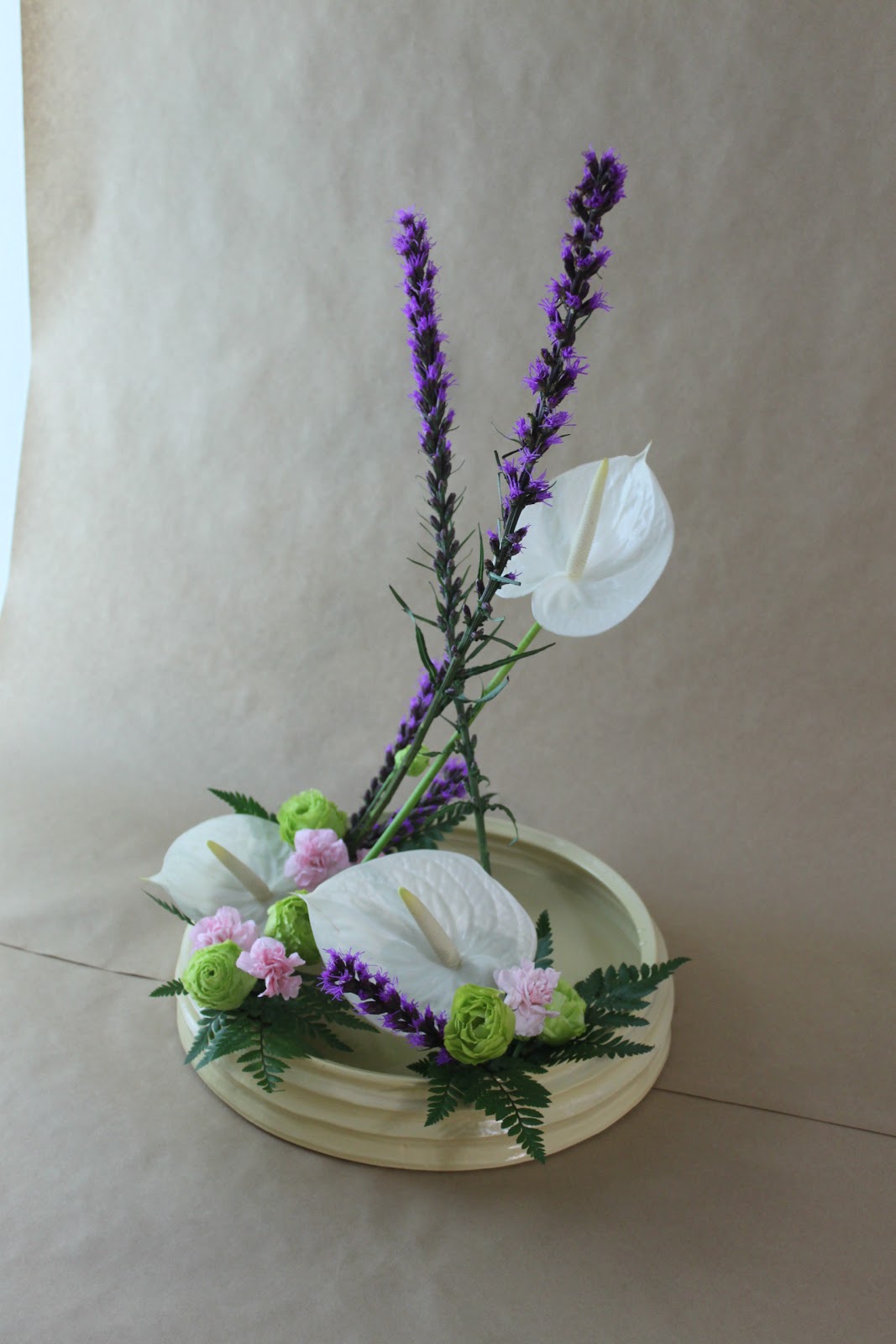
Recently, a new ikebana style has been introduced by the headmaster into the Ohara School of Ikebana. The name of the new style is Hanakanade. Hana means flower and kanade means to play or perform; so I guess in English you would call it Playing Flowers? Maybe? I'm not sure, so don't quote me on it!
In Ohara Ryu Ikebana, most of the time the flowers in an arrangement flow over the boundary of the container, creating more space and depth in the arrangement. This new style does the opposite. Hanakanade shows the beauty of flowers in the confined space of the container, but doing so in a vertical way.
The three main stems of the arrangement flow up above the container, crossing, and then forming a right triangle in the air with the tips of the stems. The base of the stems are then covered with other flowers and green material, all within the confines of the container. It sort of looks like the circular form and the hanamai form have been combined into a new form.
Last weekend, there was a special demonstration by one of the top teachers of the school. He demonstrated seven different arrangements using seasons flowers and other arrangement using flowers chosen for their colors and textures. Placing the three main stems doesn't take much time, but covering the base of the stems, trying to keep a balance and harmony in the arrangement takes quite a while.
I wanted to try my hand with the new style. I chose flowers based on their colors and textures instead of season flowers. I used liatris, anthurium, spray carnation, prairie gentian, and leather leaf.
Did you notice the nice container, too? Two friends gave it to me for my birthday, and I hadn't used it, yet. I thought the yellow color went well with the purple and pink in the arrangement. It's a very nice container, and I love it! Thanks, you two!
Oh, and sorry about the pictures. For some reason I couldn't get my editing program running to erase the line from where the two sheets of paper come together. I bought a rollscreen to use as a backdrop, but I just haven't put it up, yet. Once that's done, I won't have to use the editing program. One of these days . . .
In Ohara Ryu Ikebana, most of the time the flowers in an arrangement flow over the boundary of the container, creating more space and depth in the arrangement. This new style does the opposite. Hanakanade shows the beauty of flowers in the confined space of the container, but doing so in a vertical way.
The three main stems of the arrangement flow up above the container, crossing, and then forming a right triangle in the air with the tips of the stems. The base of the stems are then covered with other flowers and green material, all within the confines of the container. It sort of looks like the circular form and the hanamai form have been combined into a new form.
Last weekend, there was a special demonstration by one of the top teachers of the school. He demonstrated seven different arrangements using seasons flowers and other arrangement using flowers chosen for their colors and textures. Placing the three main stems doesn't take much time, but covering the base of the stems, trying to keep a balance and harmony in the arrangement takes quite a while.
I wanted to try my hand with the new style. I chose flowers based on their colors and textures instead of season flowers. I used liatris, anthurium, spray carnation, prairie gentian, and leather leaf.
| Hanakanade |
| view from above |
| view from straight on |
Did you notice the nice container, too? Two friends gave it to me for my birthday, and I hadn't used it, yet. I thought the yellow color went well with the purple and pink in the arrangement. It's a very nice container, and I love it! Thanks, you two!
Oh, and sorry about the pictures. For some reason I couldn't get my editing program running to erase the line from where the two sheets of paper come together. I bought a rollscreen to use as a backdrop, but I just haven't put it up, yet. Once that's done, I won't have to use the editing program. One of these days . . .
7/22/11
Water Flowers
One of the special characteristics of Ohara-ryu Ikebana is it's use of water flowers -- water lily, lotus, calla lily, and pond lily. All of them have special characteristics that are showed off in the way that they are arranged but have a short life in the container, so they are appreciated very much for their fleeting beauty and cooling effects on a hot summer day.
I recently had the opportunity to do a couple of different water arrangements. The first was of calla lily. It is done in the upright style and is very specific in the way in which the leaves and the calla lily are placed in the container. The arrangement has three flowers and eight leaves. Calla lilies last for over a week, but the leaves of the plant are very delicate and last but a few days. Summer is the only season that the arrangement can be done, so it is a once a year arrangement, if you are lucky enough to have the materials to do it.
The other arrangement I did used water lilies. The arrangement depicts the edge of a stream or pond with the Spirea giving the effect of a lush bank on the waters edge. Bullrush is also added as a tall filler, and two water lilies are placed in the arrangement, one at the back and base of the Spirea, and one in the front of the container pulling the eye forward and giving space to the arrangement and also a sense of a water lily floating on the surface of the water out in the pond or stream. The water lily also only last a couple of days, but when they are bloomed out, they are so cool and refreshing to look at. They rules for the placement of the flowers are also determined, like the calla lily above. The arrangement has two flowers, five leaves, two rolled leaves that have not unfurled over the surface of the water, and two small filler leaves.
Both of the arrangements bring the outdoors in and help to cool you off on the hot, humid days here in Japan. I love the water droplets on the leaves of the water lilies, now if I only had a small goldfish swimming in the container. I can definitely feel summer with these arrangements.
*a couple of bonus photos of other summer arrangements
I recently had the opportunity to do a couple of different water arrangements. The first was of calla lily. It is done in the upright style and is very specific in the way in which the leaves and the calla lily are placed in the container. The arrangement has three flowers and eight leaves. Calla lilies last for over a week, but the leaves of the plant are very delicate and last but a few days. Summer is the only season that the arrangement can be done, so it is a once a year arrangement, if you are lucky enough to have the materials to do it.
![]() |
| Realistic Landscape in the Upright Style with Calla Lily and Bullrush |
The other arrangement I did used water lilies. The arrangement depicts the edge of a stream or pond with the Spirea giving the effect of a lush bank on the waters edge. Bullrush is also added as a tall filler, and two water lilies are placed in the arrangement, one at the back and base of the Spirea, and one in the front of the container pulling the eye forward and giving space to the arrangement and also a sense of a water lily floating on the surface of the water out in the pond or stream. The water lily also only last a couple of days, but when they are bloomed out, they are so cool and refreshing to look at. They rules for the placement of the flowers are also determined, like the calla lily above. The arrangement has two flowers, five leaves, two rolled leaves that have not unfurled over the surface of the water, and two small filler leaves.
| a close up of the water lilies |
![]() | ||
| Realistic Landscape in the Slanting Style with Spirea, Bullrish, and Water Lily |
Both of the arrangements bring the outdoors in and help to cool you off on the hot, humid days here in Japan. I love the water droplets on the leaves of the water lilies, now if I only had a small goldfish swimming in the container. I can definitely feel summer with these arrangements.
*a couple of bonus photos of other summer arrangements
| Circular Form with Calla Lilly, Smoke Tree, Hybericum, and small blue flowers from the yard |
| Circular Form |
| Natural Landscape of Spirea, Hosta Leaves, and Japanese Bellflower |
6/26/11
Summer Ikebana
It's almost the end of June, and the rainy season has started here where I live. Usually during this time of year, it is hot and humid. But this year, it has been unseasonably cool -- which I love! We've had a few hot days, but they've been few and far between. I wish this trend in the weather would last all summer, but I'm sure it will be hot and humid again and I will be wishing for the cold and snow of winter. Until the cooler winter comes, I try to cool myself off with my ikebana arrangements.
In Ohara-ryu, part of the beauty of the arrangements is the way careful attention is paid to the seasons and how to portray them indoors in a confined container. During the summer months, flowers, branches, and leaves are abundant. Different colors, shapes, and textures give you so many options to choose from. I try to choose things that look cool and refreshing and also show off the water of the container, helping to give a cool and refreshing feeling to the work.
A couple of weeks ago, I did a natural summer landscape. My image was that of a bank beside a flowing stream. I used the Japanese natsu haze branch as my basis to fill out the space and reach across the water's surface. I added a few Hosta leaves to emphasise the land, and then used a single Star Lily to fill in the space and become the star of the arrangement. I tried to be careful with the placement, puling the Lily forward and giving the sense of a cool breeze. I also trimmed many leaves off of the natsu haze branch to also give a sense of lightness to the work. If there are too many leaves, it feels crowded and hot. Trimming the leaves is one of the hardest things to do for me. If you take too many off, the branch looks naked, but if you leave to many on, it feels hot and crowded. But this time, I think I struck the perfect balance.
Having an arrangement like this brings the outside in and also gives the sense of a cool breeze on a hot summer day.
Last week, I wanted to do another typical summer arrangement. I did a Traditional Color Scheme Arrangement using Hosta leaves and Chrysanthemum in the Upright Style. Here in Japan, Hosta plants are everywhere, and they represent summer to me. In this style, the position and angle of three of the stems are set, but once you have the basic form of the arrangement, you can play with the lengths and angles of the other stems. The Hosta leaves also have a cooling effect for me. And if you spray water on the leaves, the water beads up, giving a glistening effect to the leaves making them seem even more cool. They are definitely one of my favorite materials to work with.
I tried to use a paper background for the first time. I thought it might make it look a little more professional and bring more attention to the flowers. What do you think?
So if you are feeling hot this summer, try some cool, refreshing flowers to cool you off.
In Ohara-ryu, part of the beauty of the arrangements is the way careful attention is paid to the seasons and how to portray them indoors in a confined container. During the summer months, flowers, branches, and leaves are abundant. Different colors, shapes, and textures give you so many options to choose from. I try to choose things that look cool and refreshing and also show off the water of the container, helping to give a cool and refreshing feeling to the work.
A couple of weeks ago, I did a natural summer landscape. My image was that of a bank beside a flowing stream. I used the Japanese natsu haze branch as my basis to fill out the space and reach across the water's surface. I added a few Hosta leaves to emphasise the land, and then used a single Star Lily to fill in the space and become the star of the arrangement. I tried to be careful with the placement, puling the Lily forward and giving the sense of a cool breeze. I also trimmed many leaves off of the natsu haze branch to also give a sense of lightness to the work. If there are too many leaves, it feels crowded and hot. Trimming the leaves is one of the hardest things to do for me. If you take too many off, the branch looks naked, but if you leave to many on, it feels hot and crowded. But this time, I think I struck the perfect balance.
| Summer Natural Landscape arrangement Natsu Haze, Hosta Leaves, Star Lily |
Having an arrangement like this brings the outside in and also gives the sense of a cool breeze on a hot summer day.
Last week, I wanted to do another typical summer arrangement. I did a Traditional Color Scheme Arrangement using Hosta leaves and Chrysanthemum in the Upright Style. Here in Japan, Hosta plants are everywhere, and they represent summer to me. In this style, the position and angle of three of the stems are set, but once you have the basic form of the arrangement, you can play with the lengths and angles of the other stems. The Hosta leaves also have a cooling effect for me. And if you spray water on the leaves, the water beads up, giving a glistening effect to the leaves making them seem even more cool. They are definitely one of my favorite materials to work with.
| Traditional Color Scheme Arrangement Hosta Leaves and Chrysanthemum |
I tried to use a paper background for the first time. I thought it might make it look a little more professional and bring more attention to the flowers. What do you think?
So if you are feeling hot this summer, try some cool, refreshing flowers to cool you off.
5/30/11
Spring Exhibition
Every year, during May, there is a prefectural-wide ikebana exhibition. Different schools of ikebana participate over a 4 day period with a total of about 450 people exhibiting an arrangement. I took part and made an arrangement using green and white, something that I thought would look fresh and bright.
I went to the flower shop the day before the exhibition and chose my flowers. I was excited with the combination of flowers and the different colors and textures of the materials. I went to the exhibition hall and did my arrangement the evening before the opening of the exhibition. I thought it turned out very nice.
The white hydrangea added a nice weight to the arrangement that pulled the two sides of the form together, balancing the different materials to the left and right of the center. But, I was a little worried -- hydrangea are notorious for not absorbing water and wilting quickly. I had applied some "magic medicine" to the stems to help the flowers absorb the water and thought that I would be OK.
The next morning, before the exhibition opened to the public, I went to check on the flowers. And yes, the top hydrangea had wilted! I had a little less than an hour to do something before the doors opened, so I rushed to the flower shop and tried to find something else to replace the hydrangea. Luckily, they had some white lilies, so I bought three stems and raced back to the exhibition hall. By that time, I only had about 30 minutes left to change my arrangement. I carefully pulled out the hydrangea and inserted the lilies. I also rearranged the small ball-like flowers and finished just before the first people arrived.
I was happy with the result, but liked the first arrangement better. If I had had more time, I would have taken everything out of the vase and rearranged the materials. Oh, well. . . it still looked fresh and bright! Needless to say, the arrangement held though the rest of the exhibition.
I went to the flower shop the day before the exhibition and chose my flowers. I was excited with the combination of flowers and the different colors and textures of the materials. I went to the exhibition hall and did my arrangement the evening before the opening of the exhibition. I thought it turned out very nice.
![]() |
| Radial Form with Cala Lily and Hydrangea |
The next morning, before the exhibition opened to the public, I went to check on the flowers. And yes, the top hydrangea had wilted! I had a little less than an hour to do something before the doors opened, so I rushed to the flower shop and tried to find something else to replace the hydrangea. Luckily, they had some white lilies, so I bought three stems and raced back to the exhibition hall. By that time, I only had about 30 minutes left to change my arrangement. I carefully pulled out the hydrangea and inserted the lilies. I also rearranged the small ball-like flowers and finished just before the first people arrived.
![]() |
| Radial Form with Cala Lily and white Lily |
Subscribe to:
Posts (Atom)