ikebana and life in japan

a blog about ikebana and life in japan

3/25/13

Radial Form Ikebana Explained

Recently, in one of my classes, I have been teaching some of my students how to create a Radial Form ikebana arrangement.

The Radial Form is part of Advanced Hana-isho. It is a kind of ikebana that brings out the unique characteristics of the materials in a highly decorative work. They are created for the spaces where people live and work. Some of the forms can be viewed from the front only, and others can be created to be viewed from all sides.

The forms of Advanced Hana-isho have some special characteristics:
1. They can be created to decorate any kind of space, and the container used can be anything, including articles used in daily life, like cups, bowls, or plates.
2. The beauty of color is central to creating Hana-isho; however, combinations of materials that express the beauty of the season or their formal, sculptural beauty are also possible.
3. The length of the main stems and auxiliary stems, their angles, and the positions at which they are inserted are free.
4. There are three main stems, the Subject, the Secondary, and the Object.
5. The Radial Form can be arranged either in a shallow container or in a tall vase.

With all that said, I know it may sound complicated, but it is easy if you follow the guidelines and look at the materials carefully!


Radial Form (front view only)
Anthurium, prairie gentian, Dracaena godseffiana "gold dust"

In the Radial Form, the materials spread out from a central axis along the midway line of the container. I like to think of it as the spokes of a bicycle wheel.


From the central axis, all of the spokes of the wheel radiate out, creating lines of symmetry.


Here, anthurium is used as the Subject and the Secondary of the arrangement. Prairie gentian is used as the Object. And the "gold dust" is used as the green of the arrangement, which helps to meld all of the materials together.


When viewed from above, the lines of symmetry can be seen. The Subject can be on the left or right side, depending on the characteristics of the materials. Here, the Subject is on the right and the Secondary is on the left.


Here is the view from above with the lines of symmetry outlined. The Subject is the longest stem in the arrangement. The length is free, but it should have balance with the container. It is placed on the midway line of the container and extends out, giving full play the horizontal beauty of the anthurium. The Secondary is placed on the opposite side -- here on the left -- also along the midway line of the container. The length of the Secondary can be from 1/2 to the same length of the Subject. My personal taste is to make it a little shorter than the Subject, but that's just me! Next, the object, which can be from 1/3 to 1/2 the length of the subject, is placed at the center of the axis of symmetry (the green dot in the middle), with a variation also extending forward on the axis of symmetry. These are the three principal stems of the arrangement.

The Subject side should be the stronger side, so I have used two additional stems of anthurium. They are variations of the Subject and should be arranged within 30 degrees on either side of the Subject. The Secondary side uses one additional anthurium. It can be placed on either side of the Secondary, but must also be within 30 degrees of the Secondary stem. Here, I have placed it in the front.

 
Additional stems of prairie gentian are arranged with interesting variations to give the Object group a bit more weight to balance out the arrangement. The "gold dust" is also placed on either side of the Object group, helping to connect all three principal stems and make a cohesive arrangement. Some of the "gold dust" is low in the arrangement, and some is high in the arrangement. One side is also short, with the other side a little longer. This unbalance helps to balance out the arrangement -- the magic of ikebana!


You may be thinking, "What is going on with this picture?" There is meaning in the madness!

Here you can see the pink line goes through the middle of the arrangement -- the axis of symmetry. The tall Object leans slightly to the left of the line, creating some movement within the Object group. However, the Object that extends to the front must be on the axis of symmetry. This helps to unify the work with a central starting point for all other branches.

As you can see, all of the Subject and Secondary materials are placed at varying heights within the arrangement -- no two branches are at the same height (the red dots and red lines). The length of the branches are also all different. This makes the arrangement more interesting and creates points of interest throughout the linear form of the arrangement.


With this arrangement, I have focused on the use of color, but seasonal materials could also be used. An arrangement like this can be placed anywhere within your home or work space. Because of it's linear shape, it is perfect for a low table against a wall or on the mantel of a fireplace. Creating a Radial Form that is multisided would lend itself to be perfect for a table centerpiece. It is a highly decorative form that brings out the beauty of radial symmetry and is perfect for today's modern homes.


Please feel free to leave a comment or a question about the From in the comment section below!

2/27/13

Video Slide Show of Solo Exhibit Arrangements

This has been a cold, snowy winter here in Hanamaki. There has been snow on the ground since before New Year's. And I love it!

I love the cold weather and the ground covered in a blanket of white. It makes everything so serene and peaceful. I hope that there are still a few more good days of heavy snow before spring comes.

Until then, to tide you over, I made a small video of the arrangements I did for my first solo exhibit. You can read more about that in a previous post here.


Feel free to leave a comment and tell me what your favorite arrangement was.

I think mine is the the landscape arrangement that looks like a forest. Or it might be the Rinpa arrangement. It's too hard to choose just one!

1/19/13

Ikebana -- Living Flowers, Living Art, an exhibit

While home for Christmas and my winter break, I did something that I still can't quite believe I did.

I had my first solo ikebana exhibit!

I was home longer than usual this year because I had a nice break from work -- the kids I teach were on winter break. I had casually mentioned to my mom while talking on the phone with her one day that it would be nice to have an exhibit while I was home. I want to emphasize -- casually mentioned.

Well, I began to think about it more, she began to think about it more, checking on locations and starting to contact people. I had also casually mentioned it to my ikebana teacher before I left for home, but still wasn't sure if I could pull it off. I had bought a few containers to take home with me, just in case.

The day I arrived back in Arkansas, I went to the library. My mom had contaced different places around town, and the library had a room that I could use. The room was HUGE! But, I had found a place and decided that I would do it. I think I had a mini panic-attack in my mind when I finally decided to do it!

I contacted several local flower shops in the area, and Shirley's Flowers, Inc. were extremely helpful in trying to find all of the materials that I wanted to use. I had a long list of flowers and branches and wanted them in about a week. It was a hard order to fill, but she was able to find almost all of the materials that I wanted to use. I am so grateful to her for all of the extra work she put in to help me out.

I bought a few more containers, gathered some that my mom had in her house, and began to look around for some other materials that I could use. I live in the country, so while out driving one day, I spotted some branches that had fallen from the trees onto the side of the road. I snatched them up and put them on the back of the Jeep. I'm sure people looked at the Jeep strangly with all of the braches and different materials that were sticking out in all directions. But, they were just the branches and materials that I needed to finish all of the arrangements.

My mom was also a big help with the Zokei works. We worked on them for many, many, many hours, twisting coffee filters and hot glueing cups together. If she hadn't have helped me, I would have never got them finished on time. Thank you!

The night before, I did a little pre-planning. I made the landscape arrangement at home and also cut the branches of oak for the Bunjin arrangment. The next day, I spent the entire day at the library constructing the other 11 arrangements. I think I stopped for maybe 10 minutes to wolf down my lunch. I thought I would never finish everything on time, but I did. Barely!

On Friday, January 4 and Saturday, January 5, 2013, at the Bentonville Public Library in the Walmart Community Room, 400 people came to see the exhibit, "Ikebana -- Living Flowers, Living Art." I was surprised at the turnout, but many people were very interested in ikebana and flowers. Family, friends, and people from all over Northwest Arkansas came to see a little piece of Japanese culture and the thing I love to do. I was so glad that I could share this with everyone. It was a lot of work, but so worth it in the end. But, I think it will be a while before I do anything like that again. Especially by myself!

I hope you enjoy looking at the pictures and the explanations that I included for each work.


Rising Form
The Rising Form expresses the beauty of the rising appearances of materials that are grouped at the center of the container.

Materials:
Bells of Ireland, dianthus, leather leaf


Inclining Form
The Inclining Form expresses the beauty of the slanting appearances off materials that are grouped together at the center of the container.

Materials:
Yanagi makizuru, gerbera daisy, foxtail fern


Moribana, Slanting Style
In this Color Scheme Moribana in the Traditional Method, bird's nest fern is arranged to look as it does in nature, and the eight-leaf form has a beautiful, perfectly ordered appearance.

Materials:
Bird's nest fern, carnation, stock


One-Row Form (front-view)
The composition is created with three principal stems arrayed in a row with an interesting sense of rhythmic variations in the height and spacing of the materials.

Materials:
Mitsumata, hydrangea, mum, foxtail fern, Asparagus myriocladus


Hanamai
Hanamai expresses the beauty of plants brought out by their mutual interaction in three-dimensional space. Different materials may approach, touch, overlap, mix, or interlace with each other to create beauty through contrast or through harmony. It can be viewed from all angles.

Materials:
Curly willow, Peace Lily


Circular Form
The three principal stems are inserted at different points along the circumference of a circle, or in such a way that they evoke the appearance of a circle. It is a highly decorative composition created for the places where people live and work. It can be viewed from all angles.

Materials:
Calla lily, carnation, hypericum, gypsophila, sword fern


Radial Form (multi-sided)
The materials are arranged extending to the left and right of the container on an axis of symmetry, with an object flower placed at the center of the axis. This form is ideal for western style homes and can be used as a centerpiece for a table. It can be viewed from all angles.

Materials:
Bradford pear, Japanese Rose hip, Asiatic lily, mum, English yew

for Grandma


Zokei, Sculptural Arrangement
This is a freely conceived original work of ikebana. The arranger has an idea and uses it as the motif of the work. Any material or technique may be used to fulfill the aim. The composition should fit well into contemporary spaces.

In this arrangement, coffee filters were used en masse to create a column of texture that makes the viewer want to reach out and touch it.

Materials:
Coffee filters, mesh wire

for Kato Sensei


Landscape Moribana, Far View
The Traditional Method in Landscape Moribana is a form of ikebana which, while respecting the seasonal character and natural growth patterns of plants, uses an established range of materials and fixed methods of arrangement to express the beauty of a natural scene.

One of the most important principles in the method of arrangement is perspective depiction. In order to express the beauty of a natural scene in the limited space of a container, scale is very important.

In this Far-View Depiction, juniper are used to depict a tall, wooded forest at the foot of a distant mountain near a lake. The branch of driftwood represents withered trees in the forest and adds color variation to the green of the junipers. The mum are used small and low to give scale to the grand scene.

Materials:
Juniper, driftwood, mum, moss

for Dad


Bunjin Arrangement
This is a type of ikebana that is based on a Japanese interpretation of the taste of the Chinese bunjin, or literati. Emphasis is placed on the elegance and poetic nature of rare blooms, shrubs and plants. The Bunjin Arrangement in not bound by floral styles, and materials may be freely arranged to express one's subjective view of plants.

Materials:
Lichen covered oak, guzmania, pine

for Hideki


Kobana Arrangement
Kobana translates to "small flower" in English. A Kobana Arrangement uses few flowers and other materials and may be freely arranged to express the artists view of the materials.

Materials:
Pussy willow, Asiatic lily, Asparagus myriocladus

for Aunt Connie


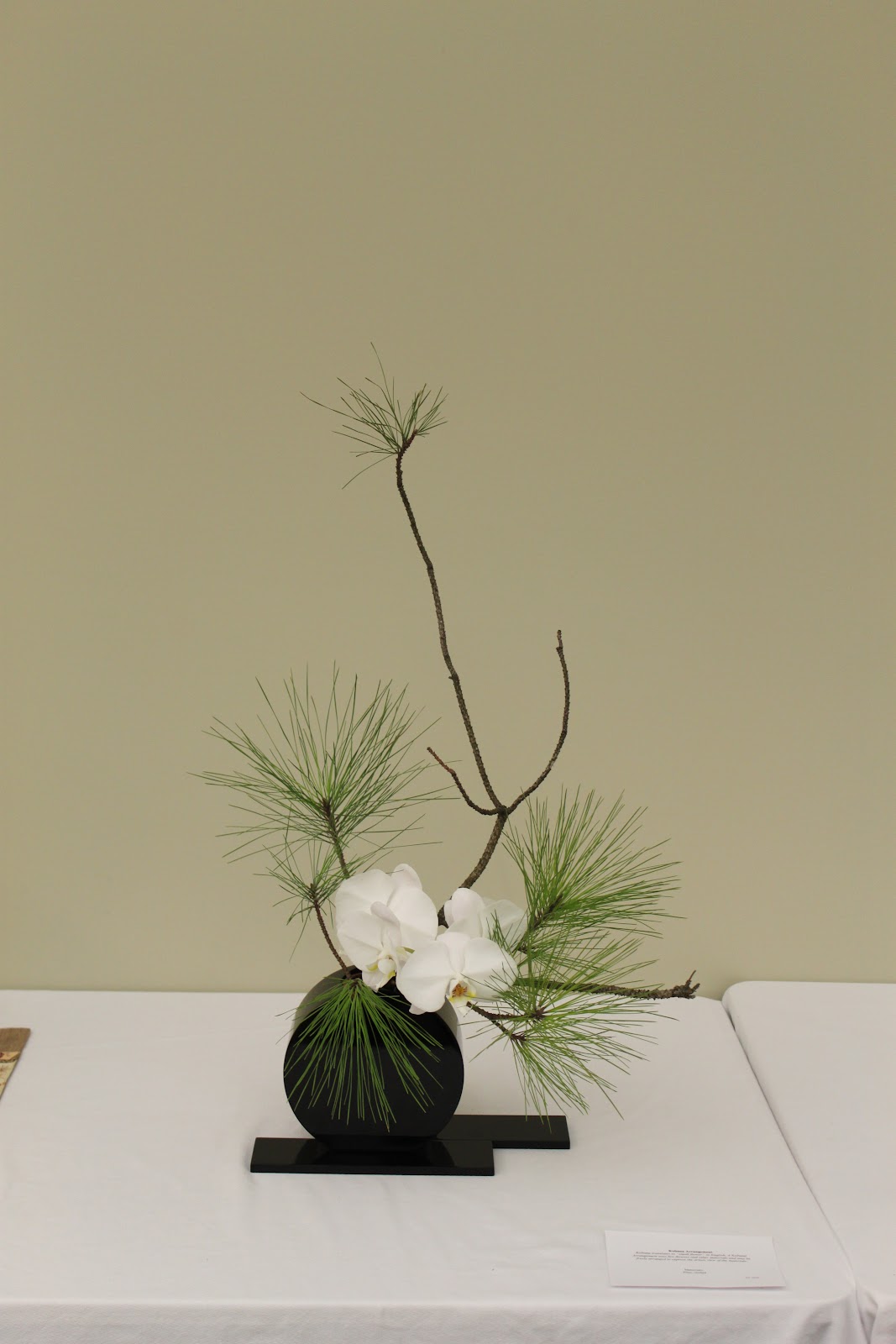
Kobana Arrangement
Kobana translates to "small flower" in English. A Kobana Arrangement uses few flowers and other materials and may be freely arranged to express the artists view of the materials.

Materials:
Pine, orchid

for Mom


Heika Arrangement, Cascading Style
Whereas Moribana was originated and developed by the Ohara Schook, Heika, literally "vase flowers," is part of the ancient historical tradition of ikebana. The Heika of the Ohara School is a modern, sophisticated interpretation of this traditional style. The Cascading Style expresses the beauty of lines that flow gracefully downward.

Materials:
Japanese rose hip, lily (Stargazer)


Zokei, Sculptural Arrangement
This is a freely conceived original work of ikebana. The arranger has an idea and uses it as the motif of the work. Any material or technique may be used to fulfill the aim. The composition should fit well into contemporary spaces.

In this arrangement, Styrofoam cups are used to create three columns of various sizes and weights. The smallest column is thin and feels light, therefore it is used tall in the arrangement. The lowest column is the largest in circumference, giving it a heavy feeling. It is used low in the arrangement to balance out the tall column. The third column is placed next to the tallest one, helping to give the left side of the arrangement some weight and balance out the heaviness of the right side.

This is a perfect example of the asymmetrical balance of ikebana.

Materials:
Styrofoam cups in three sizes


12/12/12

Christmas Ikebana with Candles

Do you know how much I love Christmas?

So much that I put my Christmas tree up on November 23, I've been listening to Christmas music non-stop since then, and I've been doing Christmas ikebana with my students for the past week. I think you can never have too much Christmas!

All last week, my students were creating beautiful Christmas arrangements. I was practicing for my monthly ikebana test, so I wasn't able to do one myself. But this week, during my lesson, I finally got to do my Christmas arrangement.

I wanted to do a one-row form arrangement, and I also wanted to use silver in my arrangement this year, too. I had a bunch of silver candles, so I decided to use those as the main "stems" of the arrangement. I spaced them out creating an asymmetrical rhythm in the arrangement. I then added the green base using some cedar and Asparagus myriocladus. I had found some dark red spray carnations at the flower shop that I thought would go well with the silver candles. I also found some white branches at the flower shop that I thought I could use to give the form some height and balance out the length of the two containers. And last, to give it a bit more sparkle (and make it a little more festive), I added some silver ornaments throughout the work. I tried to use a variety of sizes and textures to make the ornaments more ikebana-ish.

A sophisticated silver Christmas ikebana arrangement.
 I think the silver candles and white branches give it a cold, wintry feel. With the addition of the red carnations, it warms up the feel of the arrangement and gives it a little playfulness, too.


with the candles lit


Christmas light -- Christmas hope


I am going back to the states next week to spend the holidays with my family. This once a year trip is something I look forward to each year. Being able to spend Christmas with family makes the holiday perfect for me.

What makes the holiday special for you? Do you have any special plans for the season?
Feel free to leave any comments in the comment section below.

Merry Christmas!

11/13/12

Fall Colors and Coffee Filters -- Fall Ikebana Exhibition

 The past two weeks have been full of ikebana fun.

From November 2nd to the 4th, the annual Hanamaki Arts Festival was held. I have been doing an ikebana work for the exhibition for the past 12 years. It is something I look forward to each year. But this year, I had even more to be excited about -- two of my students also did a work for the exhibition!

We spent a few weeks leading up to the exhibition trying out different styles and materials, trying to figure out what each one of them would like to do. One student decided to do nageire, an arrangement in a vase. We went to the flower shop together and chose the flowers that she wanted to use. It was a very dynamic yet chic arrangement. She did a wonderful job!

fasciated willow, Dracaena, carnation
My other student decided to do a Hanamai arrangement. I think she practiced three different ways using different containers. We also went to the flower shop and she chose her materials. Her arrangement was beautiful and elegant. She also did a wonderful job!

Trumpet lily, Aspidistra, baby's breath
I was so proud of the both of them. I think they each had a good time doing their arrangements and were pleased with what they had done. One of them is already looking forward to next year and decided what she would like to do!

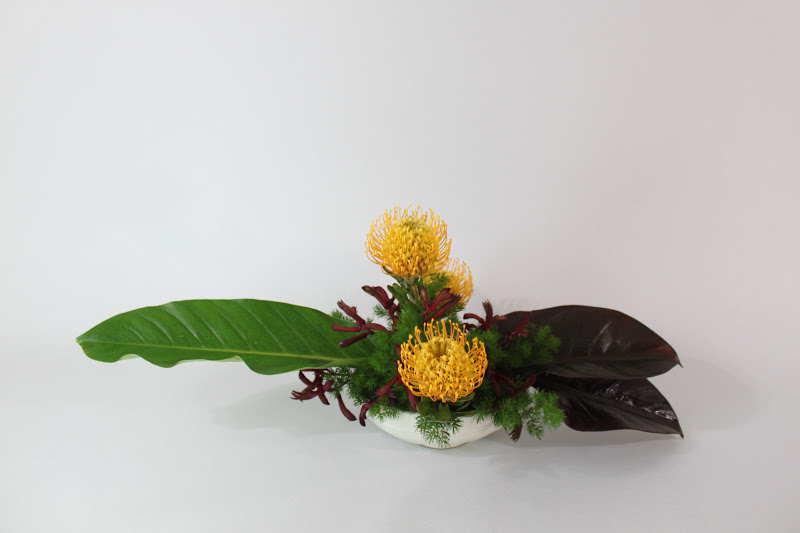
I wanted to use some orange this year in my arrangement. To me, orange is a warm fall color that you don't see used that often. I went around to several different flower shops looking for something that would inspire me, but I couldn't find anything. The day before, I finally found something orange! I knew what I wanted to do to show off the color and the beautiful flowers.


philodendron aureum, pincushion, philodendron "black cardinal", kangaroo paw, Asparagus myriocladus
 I loved the contrast of the green and black philodendron leaves, and the bright orange in the middle helped to pull the arrangement together.

The art festival is held in an old gymnasium. As you can see from the pictures, the background is not the best. The pegboard is old and worn and is used year after year. I guess you could say that it has seen a lot of art over the course of it's life, but I think it is time for it to go! After the exhibition was finished, I took my work home and rearranged it to take a better picture.


A nice background and better lighting certainly makes for a better picture!


The next weekend, November 9th to the 12th, was the prefectural fall ikebana exhibition. The exhibit is four days, but it is divided into two halves so that more people can participate in the exhibition. I did something for the first two days.

This year, I wanted to do a zoukei work. I like to use common objects and use them in a new and unusual way. This time, I decided I wanted to use coffee filters to create something. Last year, I had searched the Internet looking for Christmas wreath ideas and had stumbled upon a coffee filter wreath. It was beautiful in its simplicity. I didn't make the wreath, but the image was stuck in my head. I thought I could use coffee filters to create a large shape that would be simple yet beautiful.

After a couple of weeks of working on it on and off, and using 600 filters in the process . . .


coffee filters, chicken wire
Many people were enamored with it, trying to figure out what it was made from. Some people thought that it was made from carnations, but when you looked at it up close, you could see that it was made from paper. I was very happy with the result. I think that this is something that can be expanded upon, creating a series of zoukei pieces in the future.

Here are a few more pictures of the piece that I took at home.

the dark shadow down the middle, created from being able to see into each crumpled filter,
followed you as you moved around the piece, giving it a sense of movement


light from one side


a close-up of the tower


a very close-up of the coffee filters

It was a busy two weeks, but it was a fun two weeks. Beautiful arrangements were made by some of my students and a crazy tower of coffee filters was created by me.

How can you not love the world of ikebana?