ikebana and life in japan

a blog about ikebana and life in japan

8/23/12

Fall Ikebana

In ikebana, it's traditional to do arrangements a little ahead of the actual season around you. Summer is still in full force here with daytime highs in the 90s (30s for you Celsius people). One word -- hot.

This morning, when I got to school, the teacher's room was already in the upper 80s -- hot!! By the time I left, it was in the lower 90s -- HOT!!! Most Japanese schools, especially schools in rural areas, don't have air conditioners. Japanese people are famous for "gaman", endurance, patience, grin and bear it. Everyone talks about how hot it is, but life continues as usual -- with the sweat dripping.

To help with the "gaman", people think about the coming cooler temperatures of fall and the beautiful fall colors. Fall foods have begun to be put out in the grocery stores, there are commercials on TV with beautiful fall foliage, travel magazines with special destinations for fall are out -- all to help one look forward to the coming season.

To help you look forward to the coming season, here is my first fall arrangement of the year.

Pampas Grass, Cockscomb, Patrinia Scabiosifolia
The pampas grass is still a little green, but it has a beautiful sheen to it. I gently bent the stem and created a soft curve that created an open space on the right side of the arrangement. It was the perfect place for the tall stem of cockscomb and a tall stem of the Patrinia Scabiosifolia, the yellow flower.


The arrangement in the glow of the moonlight.
(At least that's what I was trying to achieve with the lighting.
It also helped to bring out the bumps in the screen I use to take the pictures!)
 I placed this arrangement near my door, and it is one of the first things I see when I enter my apartment. It helps to cool me down after a hot and sweaty day at school. It also makes me excited for the coming fall season and all the arrangements I will get to do.


As always, feel free to leave a comment! Which picture do you like best? What's your favorite season? What do you look forward to about fall?

8/18/12

Summer Fun with Hot Colors

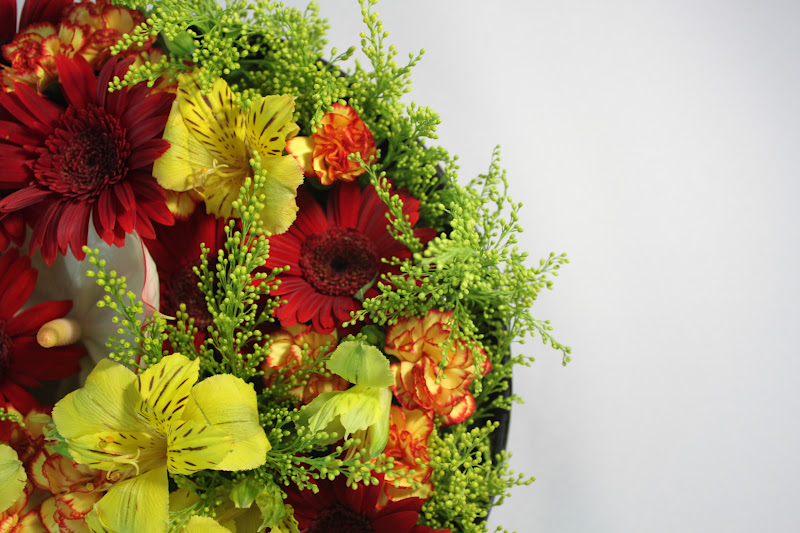
I had been looking at beautiful pictures on the Internet of these masses of flowers full of color and different textures. In ikebana, we really don't do anything like that; but I thought I might try my hand at it. I thought it would be a good study of color and texture for me, one confined to a small space and short in length.

I had fun playing around with the placement of the flowers creating masses of color and texture in the round container I usually use for moribana arrangements. Moribana means "piled up flowers" in Japanese, and I had created another form of piled up flowers in the container; so maybe there is a little ikebana in there after all!


The summery colors seem to pop a bit more against the brown of my coffee table.


Here they seem a bit more combined against the gray background of my photo screen.


I hope everyone is having a great summer!

8/15/12

Hiroki Ohara and Me

Last month I attended a workshop on Hanakanade, led by the current Headmaster, Hiroki Ohara. It was an enjoyable workshop, and I have practiced the new style a couple of times since then. I think I am beginning to understand it better, but it will take take time to fully understand it.

While at the workshop, a fellow student took a picture of the Headmaster and me. I was so engrossed in talking with Hiroki, that I didn't even realize that my picture had been taken. I thought I would share the picture with you. (Forgive the poor quality -- it's a scan of the picture.)


Hiroki Ohara and me


You can see how young the new Headmaster is. He is full of energy and new ideas. You can tell he has gained confidence in the last couple of years -- I can only imagine how hard his job must be, especially at such a young age. I know he will be a great leader for the Ohara School of Ikebana.

In the picture, you can also see my increasingly receding hairline and growing bald spot on the top of my head! Yikes! The pleasures of getting older. . . but notice I do have a smile on my face!

7/24/12

Summer Ikebana -- Contemporary and Traditional

So far this year, it has been a rather mild summer where I live in Japan. There was no real rainy season to speak of, and for most days, the high temperatures have not been above 30 degrees celcius. I have been loving it! Usually, the summers here are so hot and humid!! But by posting this on the internet, I may have jinxed myself! I hope not. I hope the rest of the summer continues to be a pleasant and bearable one.

I have two ikebana arrangements to share with you this time, both of which are summer inspired.

The first is a more contemporary arrangement known as the Circular Form. It is a multisided composition that is suitable for a western style home and can be placed on a table or buffet. It can be viewed from any side making it perfect for a centerpiece on the dining room table. The three main stems are placed along the circumference of a circle pointing outwards and producing a circular or spiral sense of movement.

Circular Form
Sunflower, Prairie Gentian, Asparagus Myriocladus, Baby's Breath
The three stems of sunflower are the main stems of the arrangement and make the basic structure of the circular motion. The asparagus myriocladus is also inserted in the same circualr motion forming a base of green in the arrangement. Prairie gentian is placed throughout to give color and balance to the work. Long stems of the prairie gentian are also used to help strengthen the circular motion. Finally, baby's breath is inserted throughout to give depth and texture to the composition. To me, it also gives a cool feeling to the arrangment, perfect for hot summer days.


View from above
All of the sunflowers extend beyond the border of the container.

The second arrangement is a Realistic Landscape Moribana arrangement. I had materials left over from a special class that I had gone to on Sunday and wanted to use them to make a large summer arrangment.

Realistic Landscape Moribana
Japanese Bell Flower,Vaccinium Oldhammi "Natsu Haze", Hosta Leaves, Solomon's Seal, Daianthus


The Japanese bell flowers, growing at the edge of a mountain stream or river, extend out over the surface of the water. The daianthus also grow in a small clump near the waters edge. The pink color helps to break up the strong green of the arrangement created by the hosta leaves, Solomon's seal and "Natsu Haze".


With the reflection of the materials extending out over the surface of the water, it helps to create a depth to the composition and also makes the viewer feel a little cool when looking at the arrangmenet.

Natural landscapes are the foundation for the Ohara School of Ikebana. Looking at these types of arrangements always gives me a sense of relief and relaxation.

Please feel free to leave a comment and let me know what you think of the arrangements. Which one do you like better? What types of materials would you use to create a realistic landscape arrangement where you live?

I hope all of you are having a great summer!

7/11/12

Hanakanade with Headmaster Hiroki Ohara

This past weekend on Sunday, July 8, I attended a workshop presented by the Ohara School of Ikebana Headmaster, Hiroki Ohara. He has created a new style, called Hanakanade, and is travelling around Japan to the different area chapters to talk about and teach how to create the new style.

For the past year, photographs of the headmaster's Hanakanade arrangements have been published in magazines, and he also showed several arrangements at his first solo exhibition held earlier in the year in Tokyo. Looking at pictures and seeing arrangements has been informative, but learning from the headmaster, himself, is something that does not happen often. Needless to say, I was very excited for the opportunity.

The main point of Hanakanade is to showcase the limited vertical space above the container. Three principal stems rise up, crossing and forming interesting lines and shapes in the space above the container. The three points from which the stems soar into the air are then covered with a base of green material, and the lower space of the container is then utilized to add a grounding to the arrangement. The three principle stems have set rules, and all the other materials, where they are placed, how they are placed, the lengths of the stems, are all free. Because of the freedom of the arrangement, something interesting and unique can be created, but it also makes it difficult to use the space wisely, creating something that enhances, not detracts from, the principal stems in the area above the container.

After the Headmaster gave a short talk an the basics of the new style, I made a Hanakanade arrangement using the materials provided. He came around and checked each person's work giving feedback and advice on how to make a better arrangement. I was happy because the only thing he changed in my arrangement was the angle of one of the principle stems, and he also took out a few of the small flowers I had placed at the foot of one of the principle stems and added a tall leaf to give a little height to the base of the arrangement.

It was a very informative workshop, and I was thrilled that I could learn directly from the headmaster; but it is still a new style that I will have to practice many times to fully understand the beauty and delicate balance of the style.

Hanakanade -- the three principal stems rising into the limited vertical space above the container.

A close up of the base. Notice the sunflower looking to the rear of the arrangement?
This helps to fill in the space of the base of the container. It is also an arrangement
that can be viewed from any angle, so having something looking to the
rear of the work ensures that the back is also pleasing.

I tried to take a picture from above, but my arms weren't quite long enough.
Here you can see how the principal stems cross and fill the space.